How Vultr Enables Agentic AI Experiences with AMD
Achieving success with Agentic AI requires changing the way AI systems are built.
Traditional Generative AI applications typically respond to a prompt. Agentic AI goes further. AI agents reason over context, decide what action to take, call tools, coordinate with other agents, and continue working across multi-step workflows.
That shift creates a new infrastructure requirement. Agentic AI requires more than a model running on a GPU. While models already depend on coordinated infrastructure, AI agents operate as distributed systems that require compute, networking, storage, orchestration, security, and observability to work together seamlessly across environments.
Agentic AI needs more than inference
In a production agentic system, the model is only one part of the workflow.
An agent may need to retrieve data from a business system, search a vector database, reason over the result, call an internal tool through a protocol like MCP, hand off work to another agent, and then trigger an action.
Each step depends on accessible, integrated CPU, GPU, networking, and storage infrastructure.
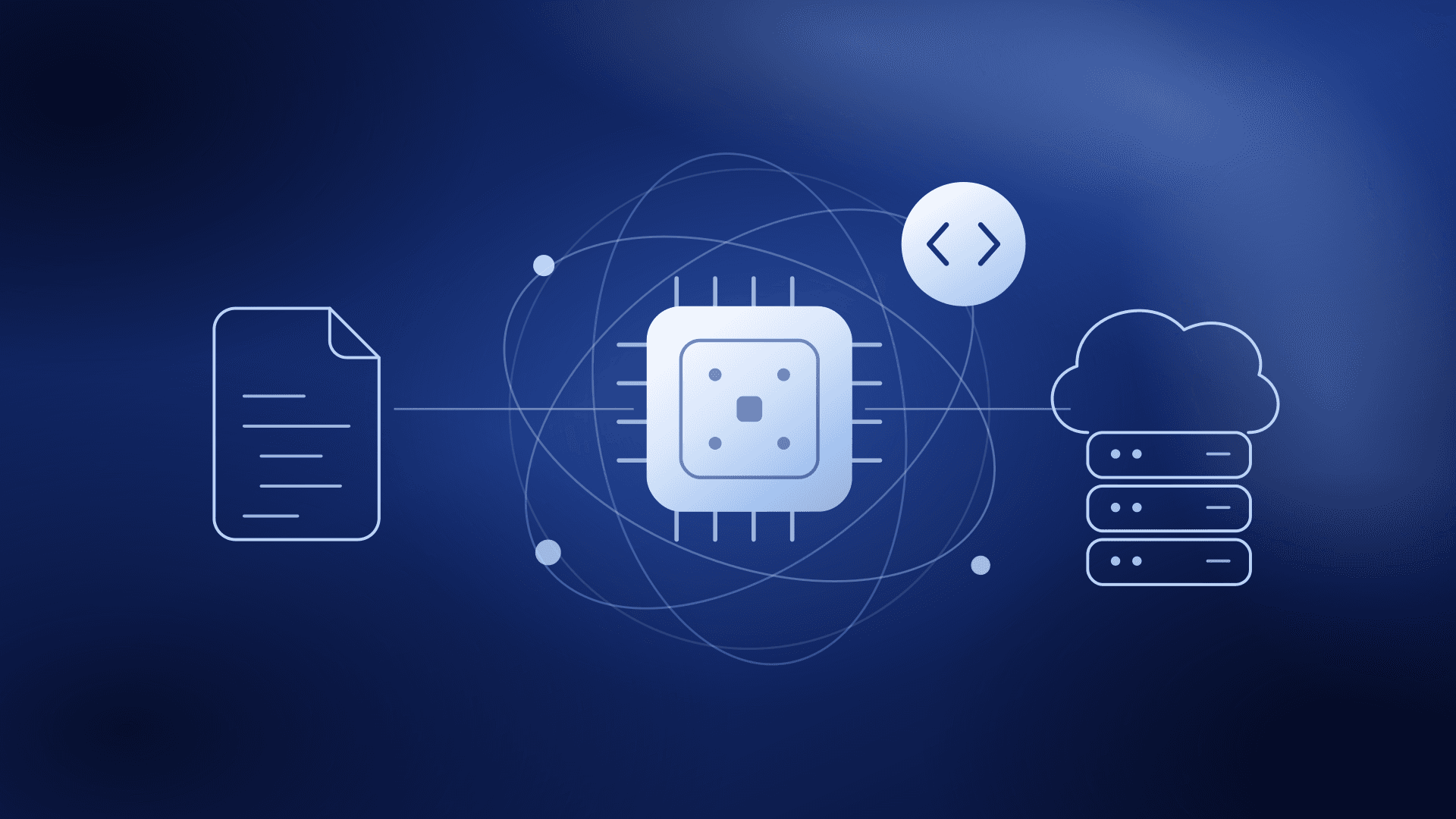
The CPU layer manages orchestration, API calls, control logic, event processing, data movement, and agent-to-agent coordination. The GPU layer accelerates reasoning, inference, and model execution. The networking layer keeps data access private and low-latency. The storage and retrieval layer ensures agents can access the right context while respecting data residency and compliance requirements.
CPUs are critical to agentic AI. Without a strong CPU infrastructure, agents can bottleneck before the workload ever reaches the GPU.
Why the stack matters
Agentic AI requires secure, regionalized, and composable infrastructure.
Agents need access to real-time, on-demand data, but that access must be controlled through role-based access control, private connectivity, and monitored via audit logs. They need vector databases close to where users and data reside, so retrieval-augmented generation can meet performance and sovereignty requirements. They need self-hosted reasoning models running in isolated environments, especially when sensitive prompts, embeddings, or business logic cannot be moved outside the enterprise.
As agentic systems mature, they also need a runtime integration layer. MCP helps agents discover and interact with internal systems without brittle, hardcoded APIs. Agent-to-agent coordination then allows multiple agents to share context, delegate work, and complete workflows across domains.
This is where traditional infrastructure begins to show its limits. Agentic AI requires a full-stack platform that can support the entire workflow from data access to inference to orchestration.
How Vultr and AMD deliver the foundation
Vultr and AMD provide a practical foundation for this new model.
Vultr VX1™ Cloud Compute provides the CPU layer required to run orchestration services, agent control planes, APIs, MCP servers, event-driven workflows, and supporting platform services.
Vultr Cloud GPU, powered by AMD Instinct™ GPUs, provides the acceleration layer for model inference, reasoning, fine-tuning, and high-performance AI workloads. Self-service on-demand Vultr Clusters provide the flexibility to optimize infrastructure to meet changing requirements without delays, reservations, or overprovisioning.
Together, the CPU and GPU layers create the foundation for production-ready agentic AI: CPUs coordinate the system, GPUs accelerate intelligence, and CPUs also manage cluster scheduling and capabilities such as GPU cluster provisioning, as well as integrated IAM that supports organizational control, security, and scalable operations.
Built on this infrastructure, AMD’s Enterprise AI software components enable developers to transition from experimentation to production more quickly. AMD Inference Microservices (AIMs) and Solution Blueprints further speed up agentic solution development by offering ready-made reference starting points, helping teams move efficiently from prototype to production.
For developers, this means they can provision GPU-optimized workspaces, allocate CPU, memory, and GPU resources, use AMD ROCm™ open software optimized frameworks such as PyTorch and TensorFlow, and build AI workloads in isolated environments without manually assembling every layer.
From experiment to production
AMD and Vultr’s agentic AI stack provides both performance and control.
Platform teams can host containerized LLMs, SLMs, and vLLMs in isolated VPCs. They can deploy workloads regionally to support compliance needs. They can use Kubernetes to manage scaling, resource allocation, and workload isolation. They can build agentic systems that integrate with internal tools, retrieve localized context, and coordinate across services.
This is what production agentic AI requires: not a single model endpoint, but a full-stack environment where every layer supports the agent’s ability to reason, act, and coordinate securely.
From GenAI applications to agentic systems
Agentic AI is pushing enterprises beyond the GenAI application model.
The future is not just about larger models; it is about infrastructure that can support autonomous, context-aware systems operating across real business workflows.
With Vultr Cloud Compute, Vultr Cloud GPU powered by AMD EPYC CPUs, AMD Instinct GPUs, and AMD AI Workbench, developers and platform teams have the full-stack foundation to build, deploy, and scale agentic AI experiences with control, performance, and flexibility.
Learn more about Agentic AI infrastructure: