Modern JavaScript and TypeScript Applications Built with Deno on Vultr
Vultr is expanding its Cloud Alliance ecosystem with Deno, the all-in-one JavaScript and TypeScript runtime, and the team behind Deno Deploy.
Together, Vultr and Deno support developers building modern web, API, edge, and AI-driven applications by combining standards-based JavaScript and TypeScript runtimes with global, predictable cloud infrastructure.
A global, modern platform for JavaScript and TypeScript
Deno radically simplifies programming by removing boilerplate code, configuration overhead, and legacy complexity. Built with native support for TypeScript, ES modules, and web standards, Deno enables developers to build for the web using the same APIs they are already familiar with.
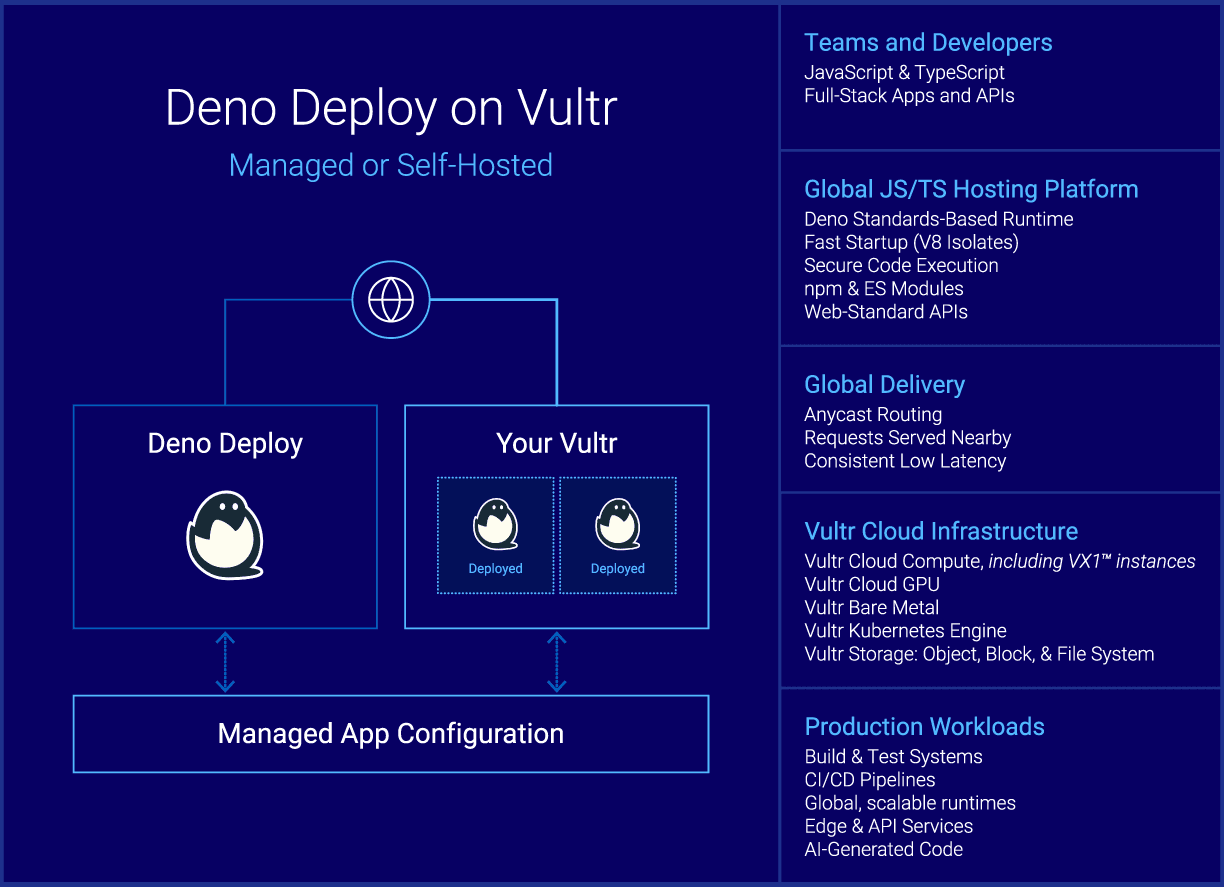
Deno Deploy extends this vision into a global JavaScript and TypeScript hosting platform, supporting everything from API servers and edge functions to full-stack applications. Using lightweight V8 isolates, Deno Deploy delivers minimal cold starts and low-latency execution across a worldwide footprint. In addition, Deno supports modern AI-driven workflows with its new Deno Sandbox release, offering programmatic, instant, safe compute through the form of ephemeral Linux microVMs.
Built on Vultr, proven at scale
Deno Deploy is built on Vultr and runs across Vultr Bare Metal, Vultr Cloud Compute, and Vultr Cloud GPU to power production workloads globally.
Vultr’s global infrastructure supports Deno Deploy’s use of Anycast routing, ensuring requests are served from the nearest available region for consistent low latency and a uniform developer experience worldwide. Deno relies on Vultr not only for customer-facing applications but also for internal build systems, CI/CD pipelines, large-scale testing environments, and execution of AI-generated or untrusted code.
As a long-time Vultr customer, Deno has validated and enjoyed the platform’s ability to deliver global availability, flexibility, and operational simplicity at scale, while also achieving meaningful cost efficiencies that support continued product investment.
“By moving Deno Deploy to Vultr, we dramatically reduced infrastructure costs, saving around $10,000 per month and freeing up more resources to invest directly into product development. As a Cloud Alliance partner, Vultr gives us the global reach and operational simplicity we need to support modern JavaScript, edge, and AI workloads at scale.”
— Ryan Dahl, CEO, Deno
Designed for modern and AI-driven workloads
Deno is seeing growing adoption among teams building AI- and LLM-driven applications, including agentic systems and platforms that execute third-party or generated code. With Deno Deploy Subhosting and Deno Sandbox, developers can safely run untrusted code inside isolated micro-VM environments.
Vultr’s cloud infrastructure enables Deno to support these workloads with predictable pricing and global reach, without the complexity or cost overhead typically associated with hyperscalers. This allows Deno to expand its AI runtime capabilities while maintaining tight control over performance and cost.
What this partnership means for customers
As a Vultr Cloud Alliance partner, Deno brings deep, real-world experience running developer platforms on Vultr infrastructure. Together, Vultr and Deno enable customers to:
- Deploy JavaScript and TypeScript applications globally with low latency
- Run edge, API, and full-stack workloads on a standards-based runtime
- Execute untrusted or AI-generated code safely and efficiently
- Benefit from predictable pricing and simplified cloud operations
Deploy on Vultr Cloud Compute instances, including Vultr VX1™ instances for cost-efficient compute without sacrificing performance
This partnership is especially relevant for teams building developer platforms, serverless and edge applications, cloud-native services, and AI-driven systems that demand both performance and operational clarity.
What’s next
By joining the Vultr Cloud Alliance, Deno strengthens an ecosystem of partners simplifying how modern applications are built, deployed, and scaled.
Together, Vultr and Deno will continue to collaborate in supporting developers worldwide, combining a modern JavaScript and TypeScript runtime with global cloud infrastructure designed for reliability, flexibility, and cost transparency.