VultronRetriever Tops the Full ViDoRe V3 Benchmark with #1 and #2 Rankings Across a Single Model Family
Enterprise retrieval workloads demand more than strong benchmark results. They require models that generalize beyond public evaluation datasets, scale efficiently in production, and remain accessible across a range of deployment environments.
We’re excited to share that the complete VultronRetriever family has achieved another major milestone.
Following the addition of the two held-out private evaluation tasks to the Massive Text Embedding Benchmark (MTEB) ViDoRe V3 benchmark, VultronRetriever continues to lead the field. Across the full 10-task evaluation suite, VultronRetriever Prime ranks #1 overall, VultronRetriever Core ranks #2, and VultronRetriever Flash is the highest-performing sub-1B model by a wide margin.
These results validate not only the models' performance but also the quality of the training methodology used to build them.
Vision language models, now running entirely on-device
Vultr is pushing the boundaries of on-device AI with what is believed to be the industry's first demonstration of a real vision language model performing fully offline document retrieval and question answering on a mobile device.

At RAISE Summit in Paris, Vultr showcased an iPhone 16 indexing a document, delivering similarity search in as little as 75–150 milliseconds and generating responses within seconds – all without an internet connection. This breakthrough demonstrates how efficient vision-language models and optimized retrieval pipelines can deliver fast, private, and responsive AI experiences directly to edge devices.

Leading the complete ViDoRe V3 benchmark
The ViDoRe V3 benchmark evaluates visual document retrieval performance across multiple industries and document types. With the addition of the two private held-out tasks (Nuclear and Telecom), the benchmark now measures performance across ten tasks, providing a stronger indicator of real-world generalization.
The latest official MTEB results place the VultronRetriever family at the top of the leaderboard.
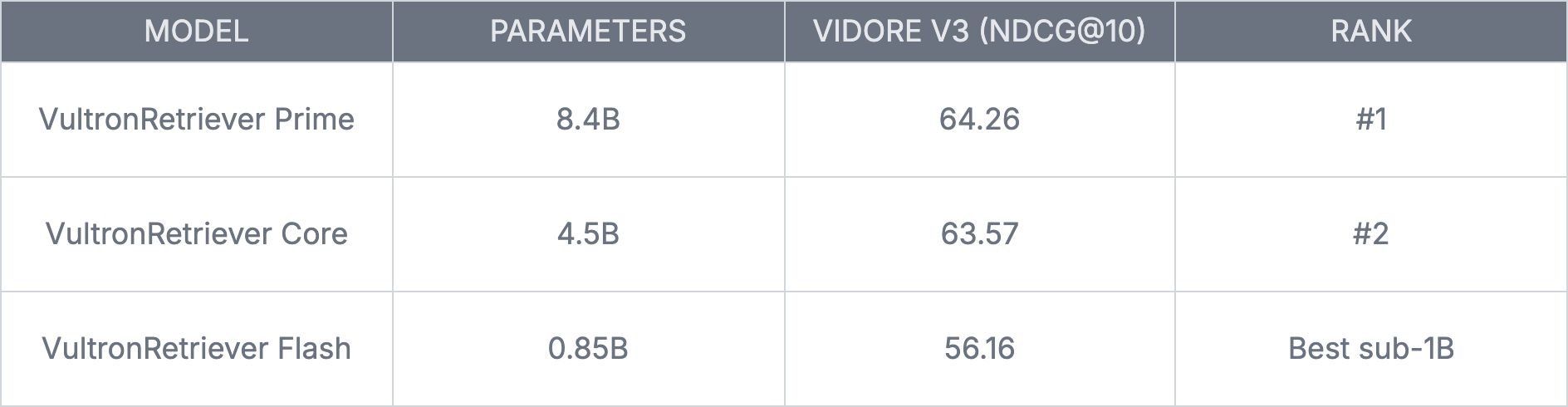
These rankings demonstrate performance across every deployment tier:
- VultronRetriever Prime is the highest-performing model on the complete ViDoRe V3 benchmark.
- VultronRetriever Core outperforms every competing model except Prime, despite using only 4.5 billion parameters.
- VultronRetriever Flash delivers the strongest results of any model with fewer than one billion parameters, while competing with models three to five times larger.
Strong performance on held-out private tasks
One of the most significant aspects of these updated benchmark results is the inclusion of two previously unseen evaluation tasks.
Unlike public benchmark datasets, the Nuclear and Telecom tasks remain private, serving as an important safeguard against benchmark overfitting. Models that have been inadvertently memorized or optimized for public datasets often experience noticeable performance drops on these hidden evaluations.
The VultronRetriever family maintained its leadership across all three model sizes, with scores closely tracking public benchmark performance.
These results provide additional validation that VultronRetriever generalizes well to previously unseen document collections rather than simply optimizing for benchmark-specific data.
Built to avoid benchmark contamination
Strong held-out performance reflects deliberate work throughout the training process.
The VultronRetriever models were developed using explicit dataset deduplication and decontamination techniques to eliminate overlap between the training and benchmark datasets.
As measured during development:
- 0% measured overlap between training data and all three ViDoRe benchmark suites
- Explicit de-duplication and de-contamination throughout training
- Consistent performance across both public and private benchmark tasks
Together, these practices help ensure that benchmark leadership reflects genuine retrieval capability rather than memorization.
Benchmark-leading performance across every deployment tier
The VultronRetriever family was designed to support a wide range of deployment scenarios—from edge devices to production-scale enterprise infrastructure.
VultronRetriever Prime (8.4B)
- #1 overall on the complete ViDoRe V3 benchmark
- 64.26 nDCG@10
- Ideal for maximum retrieval accuracy
VultronRetriever Core (4.5B)
- #2 overall on ViDoRe V3
- Highest-ranked model behind Prime
- Top ViDoRe V2 performer in its size class (66.12 nDCG@5)
VultronRetriever Flash (0.85B)
- Best-performing sub-1B retrieval model
- Competitive with models three to five times larger
- Designed for edge and resource-constrained deployments
Efficient by design
Performance alone is only part of the equation. Retrieval systems must also minimize storage, memory, and serving costs.
Every VultronRetriever model produces compact 320-dimensional embeddings, enabling:
- 8–16× smaller vector indexes andlLower storage costs
- Reduced RAM requirements
- Up to 5× faster similarity search
- Lower query-time compute
The models are also lightweight enough for flexible deployment:
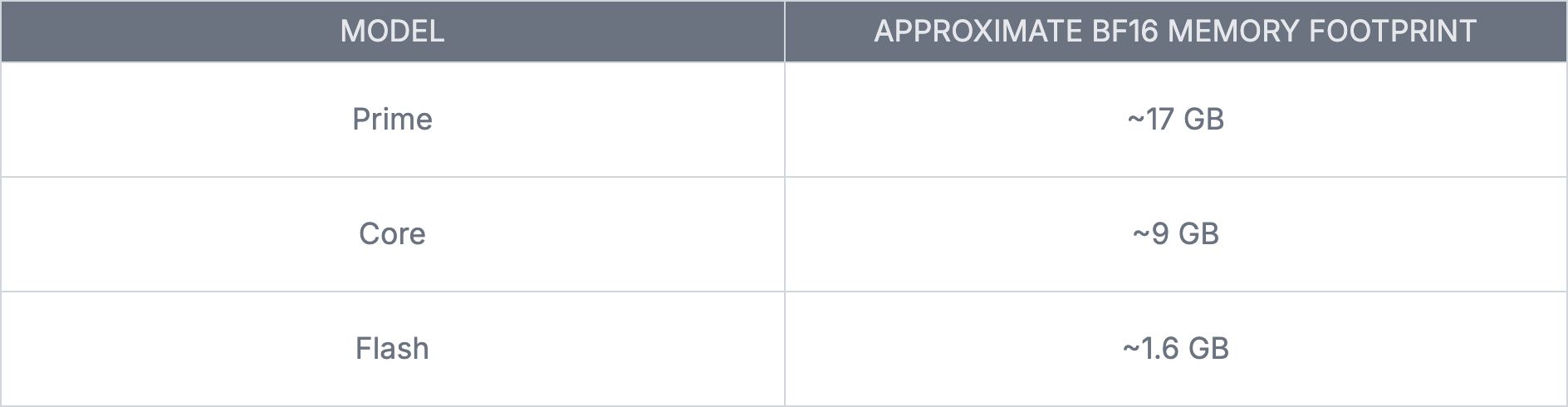
Flash is small enough for many edge deployment scenarios while maintaining state-of-the-art retrieval quality for its size class.
Ready for production
The VultronRetriever family is immediately available for production deployments.
Supported deployment options include:
- Open model weights across all three tiers
- Native support for colpali_engine
- Native vLLM pooling-runner support
- Available on Vultr Serverless Inference
- Trained and evaluated on Vultr Cloud infrastructure
The models also support retrieval across six languages:
- English
- French
- German
- Spanish
- Italian
- Portuguese
Setting a new standard for visual document retrieval
The latest MTEB results reinforce what the public benchmark results already demonstrated: the VultronRetriever family delivers state-of-the-art visual document retrieval performance across every deployment tier.
With Prime ranking #1 overall, Core securing #2, and Flash establishing a new benchmark for sub-1B models, organizations can choose the model that best fits their infrastructure requirements without sacrificing retrieval quality.
The addition of the held-out private evaluation tasks confirms that these results extend beyond public benchmarks, demonstrating strong generalization, careful dataset hygiene, and production-ready performance for real-world document retrieval workloads.
Leaderboard note: These placements are based on the official MTEB results merged on July 3, 2026 (embeddings-benchmark/results PR #587) and will appear on the public ViDoRe V3 leaderboard following the next leaderboard refresh. V3 scores represent the complete 10-task mean (eight public tasks plus two private held-out tasks) using nDCG@10.