VultronRetriever: Open Visual Document Retrieval Models Built for Scale
Organizations are increasingly turning to retrieval-augmented generation (RAG), agentic AI, and multimodal workflows to unlock value from large document collections. But retrieving relevant information from visually complex documents remains a significant challenge.
Today, we’re introducing the VultronRetriever family: A new collection of open-weight visual document retrieval models designed to deliver state-of-the-art retrieval accuracy while dramatically reducing infrastructure requirements.
Built and benchmarked on Vultr cloud infrastructure, the VultronRetriever family includes three models optimized for different deployment requirements:
- VultronRetriever Flash (0.8B parameters)
- VultronRetriever Core (4.5B parameters)
- VultronRetriever Prime (8.4B parameters)
All three models are available through the Vultr Hugging Face organization under the Apache 2.0 license and include vLLM support for production deployments.
A new approach to document retrieval
Traditional document retrieval systems often rely on text extraction pipelines that can struggle with complex layouts, tables, charts, forms, and scanned documents.
VultronRetriever takes a different approach. Each model reads an entire document page as an image, enabling retrieval directly from visual document content while preserving contextual information that may be lost through OCR-only workflows.
This makes the models particularly well-suited for enterprise knowledge bases, technical documentation, financial records, healthcare forms, research archives, legal documents, and other repositories of visually rich content.
Three models for different deployment needs
The VultronRetriever family was designed to provide deployment flexibility without sacrificing retrieval quality.
VultronRetriever Prime
At 8.4 billion parameters, VultronRetriever Prime is the flagship model in the family and currently ranks first on the public ViDoRe V3 leaderboard. Prime also ranks first on six of the eight public ViDoRe benchmark tasks, demonstrating consistent leadership across a broad range of visual document retrieval scenarios.
Prime delivers the highest retrieval accuracy while maintaining a significantly smaller retrieval footprint than competing large-scale document retrieval models. Despite competing against retrieval models using 2,560- and 4,096-dimensional embeddings, Prime achieves the top overall ranking while requiring only a fraction of the index size.
VultronRetriever Core
At 4.5 billion parameters, VultronRetriever Core delivers performance within approximately one point of the flagship model while requiring roughly half the model size.
This makes Core an attractive option for organizations seeking an optimal balance between retrieval quality and infrastructure efficiency. Core ranks within a single point of Prime on the ViDoRe V3 benchmark and actually surpasses the flagship on ViDoRe V1 (92.21 versus 92.08). It also outperforms several larger 8B-class retrieval models, demonstrating that excellent retrieval performance does not require the largest models.
VultronRetriever Flash
Designed for resource-constrained environments, VultronRetriever Flash contains just 0.85 billion parameters and a 1.6 GB footprint.
Despite its compact size, Flash outperforms many retrieval models three to five times larger, making it suitable for edge deployments, distributed environments, and cost-sensitive workloads. Flash is currently the top-performing retrieval model with 2B parameters, outperforming the next-best model in its class by approximately 7 points while trailing several leading 7B models by less than 1 point.
Benchmark-leading performance across every model class
The VultronRetriever family delivers strong results across the Visual Document Retrieval (ViDoRe) benchmark suite.
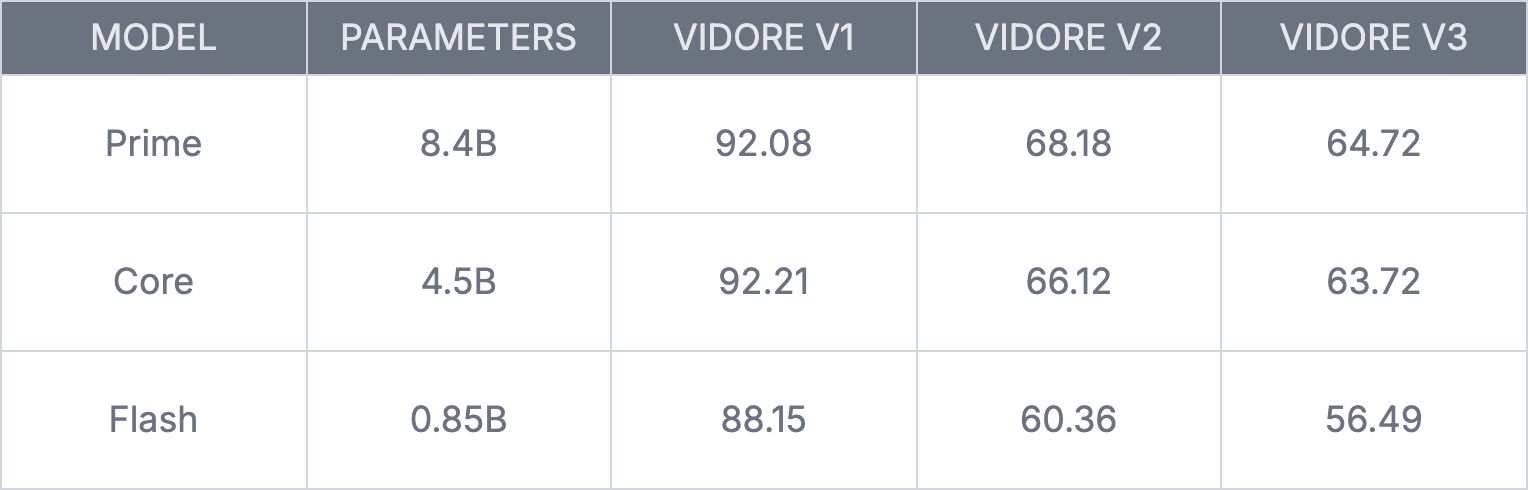
Prime ranks first on the public ViDoRe V3 leaderboard, while Core leads its model class and Flash ranks among the top-performing sub-2B retrieval models.
Across the public ViDoRe benchmark averages, every member of the VultronRetriever family ranks first in its respective size class. Core and Flash each outperform competing models in their categories by a substantial margin, reinforcing the family's ability to deliver state-of-the-art retrieval performance across a wide range of deployment requirements.
These results demonstrate that retrieval quality does not necessarily require increasingly large model footprints.
Additional benchmark evaluations are currently in progress and will be added to the public leaderboard as they are completed, providing an even more comprehensive view of the models' performance across the full evaluation suite.
Smaller indexes, lower costs
Retrieval quality is only part of the equation. As document repositories grow to millions or billions of pages, index size and query-time infrastructure costs become increasingly important.
VultronRetriever was designed with efficiency in mind.
Compared to leading 9B-class document retrieval models, VultronRetriever Prime requires significantly less storage and memory for indexing.
For a one-million-page corpus:
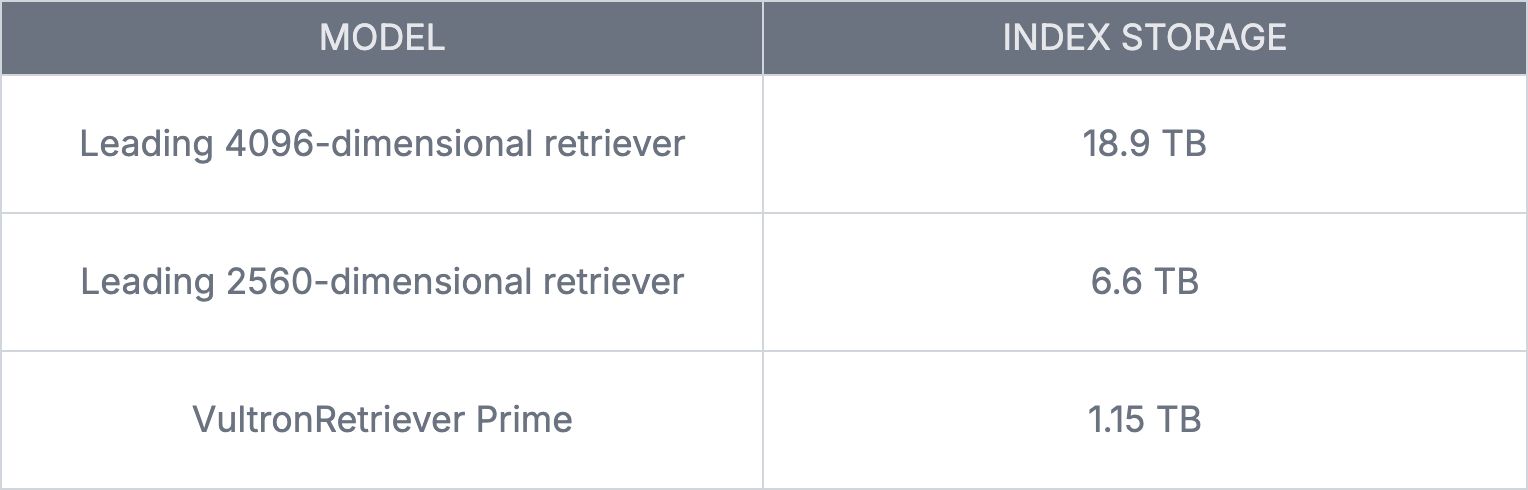
This represents up to a 16× reduction in storage requirements and approximately 15× lower query-time memory requirements.
For organizations operating large-scale retrieval systems, these efficiencies can directly translate into lower infrastructure costs and improved scalability.
Built for high-throughput inference
In addition to reducing storage requirements, VultronRetriever enables significantly faster query processing.
When tested against a 1,000-page retrieval pool using MaxSim scoring:
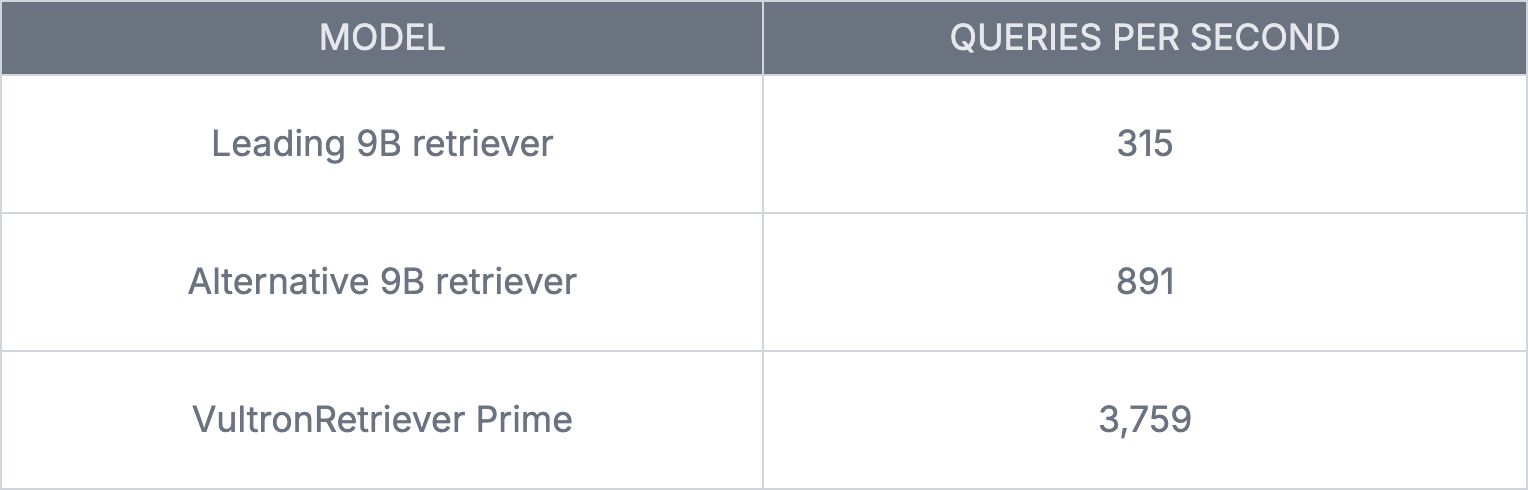
The result is up to 12× higher query throughput while operating on a smaller and more cost-effective infrastructure.
This combination of retrieval quality, throughput, and efficiency makes the family well-suited for production-scale AI applications that depend on fast document search and retrieval.
Optimized for deployment on Vultr
The VultronRetriever family was built and benchmarked on Vultr cloud infrastructure and is optimized for deployment using vLLM across both NVIDIA and AMD GPU environments.
Organizations can deploy retrieval workloads on Vultr cloud GPU infrastructure while benefiting from predictable pricing, global reach, and support for open-source AI frameworks.
Whether deploying a compact retrieval model at the edge or operating large-scale enterprise document search systems, the VultronRetriever family offers flexible options to meet a range of performance and infrastructure requirements.
Open models for the next generation of AI retrieval
As enterprises expand their use of AI agents, multimodal search, and retrieval-augmented generation, efficient document retrieval becomes increasingly critical.
The VultronRetriever family demonstrates that organizations no longer need to choose between retrieval quality and infrastructure efficiency.
With benchmark-leading performance, significantly smaller indexes, high query throughput, and an open Apache 2.0 license, VultronRetriever provides a scalable foundation for modern document retrieval workloads.
Explore the VultronRetriever family on Hugging Face and start building visual document retrieval applications on Vultr cloud infrastructure today.