Vultr Joins the Agentic AI Foundation to Advance Open, Interoperable Agentic AI
Agentic AI is moving from experimentation to production. Agents need to reason, call tools, access data, interact with other agents, and operate across distributed environments. Making that work requires more than models. It requires infrastructure, orchestration, frameworks, and open protocols that work together.
That is why Vultr is joining the Agentic AI Foundation (AAIF) as a Gold member, supporting its work to advance open standards and open-source technologies for agentic AI.
“We have a mission...to bring this vision of open, composable stacks so we can have an open ecosystem, open innovation, we can have freedom, choice, and flexibility.”
– Manik Surtani, Agentic AI Foundation
For Vultr, joining AAIF extends our commitment to an open, composable AI stack into the agentic layer. Developers should be able to choose the infrastructure, frameworks, models, tools, and protocols that fit their applications rather than being tied to a single technology stack.
The Open Source AI Stack
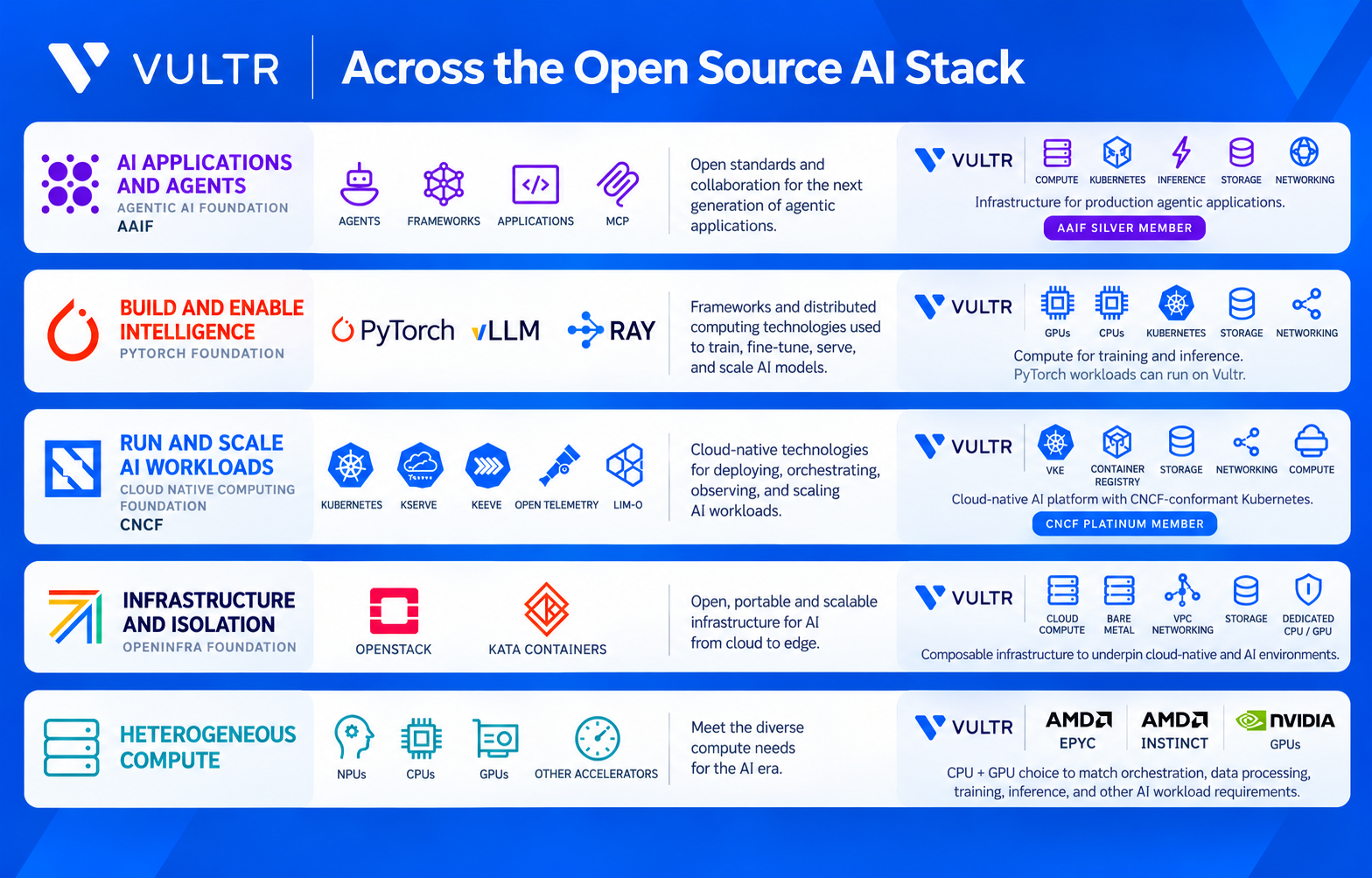
Production AI spans several layers, each solving a different part of the problem:
AI applications and agents: Open protocols such as MCP and A2A connect agents with tools, data, services, and other agents. As an AAIF Gold member, Vultr is participating in the ecosystem, which is developing this agentic layer while providing the cloud infrastructure beneath it.
Build and enable intelligence: Technologies such as PyTorch, vLLM, and Ray support model development, training, fine-tuning, and inference. Vultr Cloud GPU provides AMD Instinct and NVIDIA GPUs, along with high-performance CPU infrastructure, for these workloads.
Run and scale AI workloads: Kubernetes and CNCF technologies provide orchestration, observability, networking, and scaling. Vultr Kubernetes Engine (VKE) provides CNCF-certified managed Kubernetes, along with storage, networking, a container registry, CPUs, and GPUs.
Infrastructure and isolation: Vultr provides Cloud Compute, Bare Metal, VPC networking, and storage, giving developers the infrastructure foundation for cloud-native and AI workloads.
Heterogeneous compute: AI needs more than GPUs. Vultr provides AMD EPYC CPUs, AMD Instinct GPUs, and NVIDIA GPUs, allowing developers to match compute to training, inference, orchestration, data processing, application logic, and agent execution.
These technologies come from different open-source communities, but developers increasingly need them to operate as one stack.
Chris Aniszczyk, CTO of CNCF, made that connection during our AgentX conversation at AgentCon and MCPCon. highlighting how CNCF technologies already support AI infrastructure across inference, service mesh, and storage. His perspective reinforces why production AI depends on interoperable technologies across multiple layers of the stack.
“Open source gives them optionality.” – Chris Aniszczyk, CTO, CNCF
That optionality is practical. Developers can choose the right technology for each layer and change individual components as their requirements evolve. Enterprises gain more control over where workloads run, which technologies they adopt, and how their AI architecture develops over time.
Connecting infrastructure to agents
The agentic layer makes interoperability across the stack even more important.
An agent might query a model, retrieve enterprise data, call an API or MCP tool, communicate with another agent, and take an action. Each step can involve a different technology, service, or infrastructure resource.
AAIF projects, including MCP, goose, AGENTS.md, agentgateway, A2A, and Agent Router, address different parts of this emerging layer, creating open ways for agents, tools, applications, models, and services to work together.
Naseem Al-Naji, co-founder of AgentCat, described this during AgentX as thinking about the entire “agent's experience.” Agents increasingly need to interact across multiple tools and systems, making those interfaces part of the application architecture.
But interoperability at the agent layer is only part of the production challenge. Agents still need compute, Kubernetes, data, storage, networking, security, and observability underneath them.
That is where the layers of the stack come together.
Moving agentic AI into production
As agents move from experiments to applications and business processes, operational requirements become increasingly important.
Developers need to deploy and scale agents, securely connect them to tools and data, monitor their activity, and control what they are allowed to access.
Oz Osorio of Stacklok discussed this during Agent(X), including the importance of designing agent infrastructure for Kubernetes from the start and building identity and delegated permissions into agents and sub-agents.
For enterprises, that translates into practical questions: Which agent is acting? What can it access? What actions can it perform? How is it monitored and governed?
It also reinforces the point that AI infrastructure cannot be reduced to GPUs. GPUs are critical for training and inference, but CPUs handle application logic, orchestration, data processing, networking, agent execution, and many of the services surrounding the model.
Production agentic AI needs the full stack.
Building an open, composable AI stack
Linux created an open foundation for computing. Kubernetes established a common orchestration layer for cloud-native applications. Open AI frameworks expanded how developers build and run AI.
Agentic AI now needs the same openness at the application layer.
The goal is not for every organization to use the same stack. It is to let developers choose a model, run it on the compute that best fits the workload, orchestrate it with Kubernetes, connect it to tools and data, and build agents on top – without a single provider controlling every layer.
No single company will build that ecosystem alone.
By joining the Agentic AI Foundation as a Gold member, Vultr is extending its commitment to the open-source AI ecosystem into the agentic layer – helping developers bring together the infrastructure and technologies they need to build, deploy, and run agentic applications in production.
For developers, that means choice across the stack. For enterprises, it means the flexibility and control to take agentic AI into production on their terms.