From Hardware to AI Applications: Why the Full Stack Matters for Private Enterprise AI
Deploying AI into production takes more than GPUs.
Private Enterprise AI depends on a complete technology stack, from the physical infrastructure powering AI clusters to the software that manages AI applications throughout their lifecycle. Every component plays a role in performance, scalability, governance, and operational efficiency.
Instead of integrating multiple technologies independently, organizations are increasingly adopting pre-validated AI stacks that combine infrastructure and software into a production-ready turnkey platform.
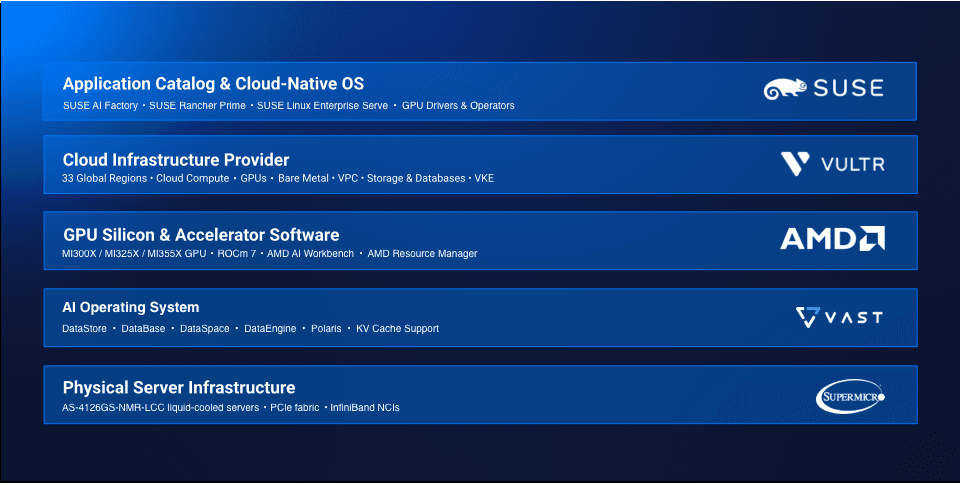
Here's what that stack looks like:
AI infrastructure
Every production AI platform starts with the right infrastructure. Training and inference workloads demand purpose-built servers that support GPU acceleration, high-speed networking, and efficient cooling, scaling from single-node deployments to large AI clusters.
Supermicro provides the AI-optimized infrastructure that powers this foundation. Designed for demanding AI and HPC workloads, its server platforms support high-density GPU deployments and the performance, scalability, and reliability required to run enterprise AI at production scale.
Enterprise data platform
AI models are only as valuable as the data they can access. Whether training foundation models, powering retrieval-augmented generation (RAG), or serving real-time inference, AI workloads depend on fast, scalable access to large volumes of structured and unstructured enterprise data.
VAST Data provides the AI Operating System that powers AI data infrastructure. Designed for AI at scale, the VAST AI OS provides enterprises with a unified data foundation across distributed environments, delivering the high-performance data services needed to efficiently feed GPUs, accelerate model training and inference, and simplify data management across the AI lifecycle.
Accelerated compute
AI performance depends on more than GPUs. Production AI requires a balanced compute architecture that combines high-performance GPUs with powerful CPUs.
AMD Instinct™ GPUs accelerate AI training and inference, while AMD EPYC™ processors orchestrate workloads, manage data movement, run Kubernetes control planes, and keep GPUs fed with data. Together, they provide the compute foundation needed to maximize performance, improve resource utilization, and scale AI workloads efficiently.
Cloud infrastructure
Cloud infrastructure provides the foundation for deploying, connecting, and scaling AI workloads. It brings together compute, networking, storage, and Kubernetes into a single environment, enabling organizations to run AI applications consistently from development through production.
As a cloud infrastructure platform, Vultr connects the underlying hardware, enterprise data platform, accelerated compute, and AI software into a unified environment that simplifies the deployment and scaling of production AI. Built on open technologies and standard APIs, the platform gives organizations the flexibility to deploy AI workloads across public cloud, dedicated infrastructure, edge, and sovereign environments while maintaining operational control.
Enterprise AI operations
Building AI models is only the first step. Scaling, governing, and operating those models in production is where enterprise AI becomes truly valuable.
SUSE AI Factory provides the software foundation for Private Enterprise AI operations. Built on Kubernetes and open-source technologies, it standardizes AI deployment with validated blueprints, GitOps automation, lifecycle management, and integrated governance.
This enables organizations to simplify AI operations, maintain consistent governance, and deploy AI applications across cloud, on-premises, edge, and sovereign environments, helping bridge the gap between AI experimentation and enterprise production.
Bringing the stack together
Production AI isn't built on a single technology. It depends on infrastructure, data, compute, cloud, and AI software working together as one platform.
Supermicro provides the AI infrastructure. VAST Data delivers enterprise data at AI speed. AMD powers AI with high-performance CPUs and GPUs. SUSE AI Factory standardizes deployment and operations. Vultr brings these technologies together on a globally distributed cloud platform, providing organizations with a validated foundation for building, deploying, and scaling Private Enterprise AI.
Why it matters
Building a Private Enterprise AI platform from individual components takes time and introduces integration complexity. A validated stack reduces that effort by providing infrastructure and software designed to work together from day one.
For organizations scaling AI, that means:
Faster deployment from pilot to production
- Simplified AI deployment and operations
- Improved CPU and GPU utilization
- Consistent AI governance across environments
- Flexible deployment across cloud, edge, on-premises, and sovereign environments
- Reduced integration complexity
Rather than spending months integrating infrastructure, platform teams can focus on deploying AI applications that deliver business value and tangible return on investment.
A foundation for production AI
Private Enterprise AI success depends on more than choosing the right model or the latest GPU. It requires a platform that seamlessly integrates infrastructure, data, compute, cloud, and AI software.
By combining Supermicro, VAST Data, AMD, Vultr, and SUSE AI Factory, organizations gain a validated, production-ready AI platform that simplifies deployment, accelerates innovation, and helps move AI from experimentation to enterprise scale.
From hardware to software, every layer is designed to help enterprises accelerate the journey from AI experimentation to production.